
Knee Arthritis Treatment. Without Surgery.
Your knee can work better than it does – less pain on stairs, longer walks, mornings that loosen on their own. Each treatment interrupts the cycle driving the damage, so the improvement lasts with ongoing care. And over time, the difference it makes only grows.
Walk Further · Hurt Less
Where You Are
If your knee has started shaping how you move through the day: stairs you avoid, walks that end earlier, mornings that take a while to loosen – you already know where you are.
Your knee can work much better than it does right now. The earlier the cycle is interrupted, the bigger the difference – in how the knee feels now and where it's heading.
How the Knee Actually Gets Better
Arthritis feeds on itself: inflammation drives cartilage loss, which drives more inflammation, while lubrication thins and the joint's own repair falls behind.
An injection delivered into the joint can interrupt that cycle directly – calming inflammation, restoring lubrication, supporting repair. In most knees all three are happening to some degree, so what fits is usually a combination matched to your knee.
Why It Works in His Hands
Dr. Tariq is a consultant interventional radiologist. Treating joints with imaging and needles instead of operating is his entire discipline.
Ultrasound guides each injection so it lands where it needs to, and visit-over-visit shows what's changing in the joint. The toolkit is broader than the cortisone shot most have had – multiple injection types, used singly or in combination depending on what your knee needs.
What Ongoing Care Looks Like
For most patients this looks like seeing Dr. Tariq 2–3 times a year. Each session takes 20–30 minutes and buys months of better function, sometimes closer to a year.
The cost is a small fraction of what a knee replacement runs. Over the years, the gap between a knee that's been treated and one that hasn't keeps growing – that's what makes this a path, not a patch.

Your Doctor
Dr. Tariq Sinan – Consultant Interventional Radiologist
He'll tell you directly if injection therapy won't help your knee – and refer you on if surgery is the right call.
- 37 years practicing interventional radiology – image-guided procedures are his entire discipline
- Specialised fellowship in joint and spine procedures, Dublin, Ireland
- Fellow of the Royal College of Surgeons (Ireland) and the Royal College of Radiologists (London)
- Trained and practiced in Ireland and Canada
- Associate Professor at Kuwait University; fluent in English and Arabic
The Full Story
For those who want to understand the approach in depth
Knee Arthritis, Honestly
Dr. Tariq's first question is where your knee actually is. The answer determines what care can do for it, and sometimes what it can't.
How knee arthritis tends to go
Knee arthritis is an active process that tends to feed on itself. More than one cycle, all pulling in the same direction:
- Inflammation releases enzymes that break down cartilage, which causes more inflammation
- Lubrication thins, increasing friction and wear on the cartilage, which feeds more inflammation
- The joint's own repair signals fall behind
- Pain leads to disuse, which weakens the muscles around the knee, which loads the joint worse
The rate of progression varies a lot. Plenty of patients plateau for years – stable joint, manageable symptoms. Others move faster. Without intervention, though, the direction tends to be the same: gradual loss of cartilage, gradual loss of function, eventually the structural collapse that makes replacement the only option.
Cartilage has very limited blood supply, so it can't repair itself once damaged. Growth factors and healing signals in the blood don't reach it.
Once the cycle is established, arthritis doesn't get better on its own – which is why interrupting it early, and keeping it from coming back, matters.
What care can actually change
An injection into the joint can interrupt the cycle at every point that drives it:
- Inflammation calmed where it's eating the cartilage
- Lubrication restored where it has thinned
- Repair signals reinforced where they've fallen behind
- Pain reduced so the muscles around the knee become usable again, protecting the joint instead of loading it
The improvement can be substantial – less pain, better function, often sustained for years. The honest limit is: cartilage that's gone doesn't grow back. But how the knee actually feels and works day to day can change a lot, and the trajectory toward surgery can be slowed, sometimes held off indefinitely. Many patients sustain function they thought they'd lost. Some never need replacement at all.
The improvement compounds. Less inflammation means slower cartilage loss. Better lubrication means less mechanical damage. Usable muscles mean better load distribution. These are small changes – but each one is the disease losing a step in the loop that's been driving it.
Where the boundary is
Some knees are past what this care can change. When cartilage is essentially gone, joint space has collapsed, and bone is grinding on bone, injection therapy can offer temporary relief but it can't change the underlying reality. If your knee is at that point, Dr. Tariq will tell you directly and refer you to an orthopaedic surgeon. The right care for that knee is replacement, and there's no benefit in delaying it.
The Treatments in Detail
Five tools in the toolkit, used singly or in combination depending on what your knee needs.
Steroid Injection
Acute flare – swollen, warm, hard to bend
The knee is swollen, warm, hard to bend. Stairs are difficult. Getting up from the floor after prayer takes real effort. You need the inflammation down so you can function.
Delivered directly into the joint under ultrasound, a steroid injection calms the inflammation within days. The swelling drops. The knee bends easier. Stairs become manageable again. It works on the inflammation side of the cycle – the part driving the most immediate damage and the most immediate pain.
Relief typically lasts weeks to months, depending on the severity of the flare. Steroids aren't for repeated long-term use because they can weaken cartilage over time. This is the tool for an acute episode, not the maintenance tool. For ongoing inflammation, the others fit better.
Ozone Therapy
The daily ache that won't quit
The acute flare has passed, but the knee still aches most days. It's not swollen anymore, but it's never comfortable. You're taking anti-inflammatories to get through, and you'd rather not keep doing that indefinitely.
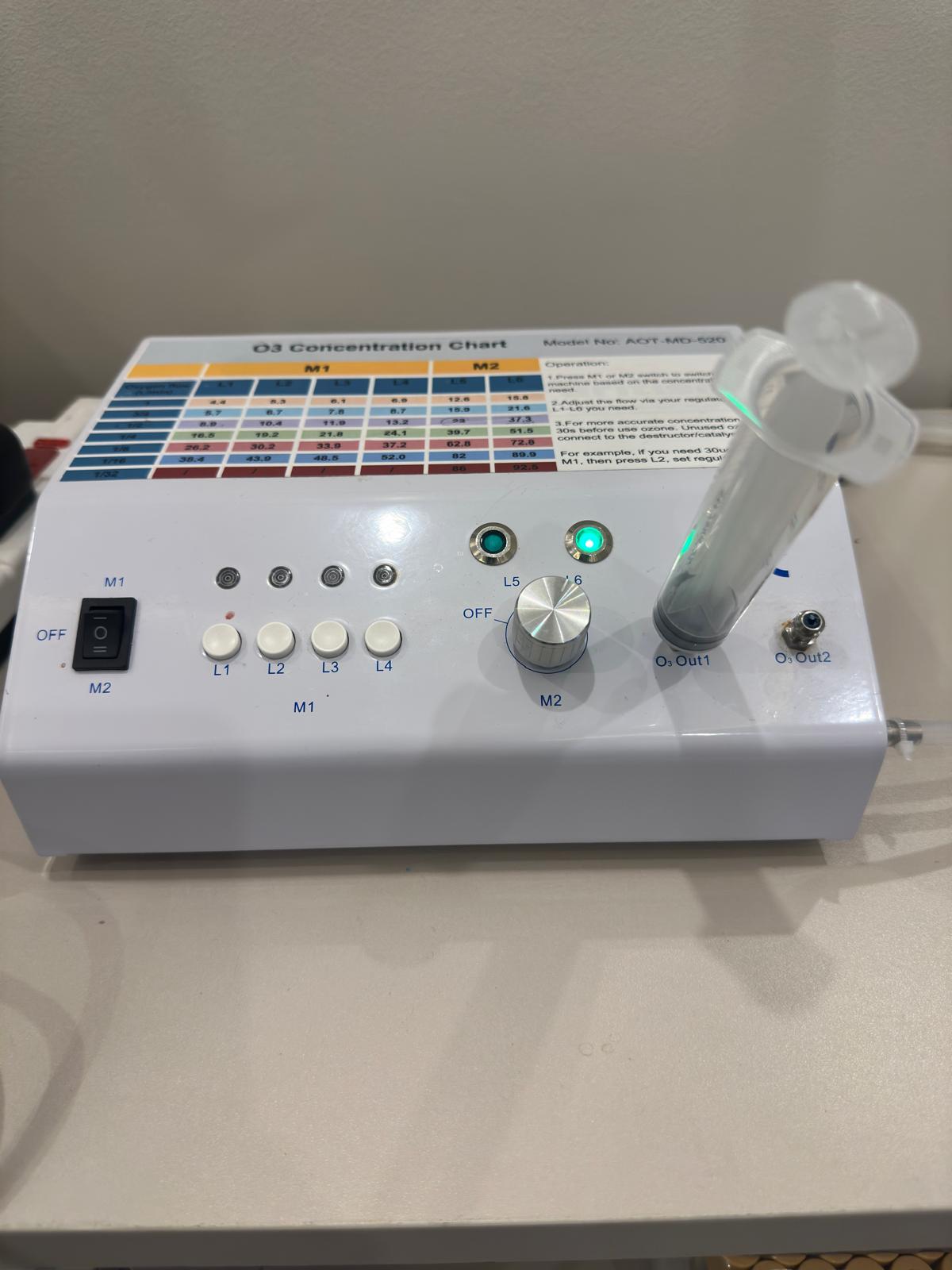
A medical oxygen-ozone mixture injected into the joint triggers your body's own anti-inflammatory response. Like steroid, it works on inflammation – but it can be repeated without the cartilage concerns. That makes it the maintenance tool for ongoing inflammation.
Relief typically lasts 3–6 months. For patients whose knee runs hot most of the year, ozone fits naturally into the every-few-months rhythm.
Hyaluronic Acid
Stiff mornings, grinding, shorter walks
The knee is stiff for the first half hour every morning. It grinds when you bend it. The walk to the supermarket that you used to do without thinking is now something you think about. The synovial fluid that cushions and lubricates the joint has thinned, and your knee feels it.
A gel-like substance injected into the joint space restores the cushion and lubrication your knee has lost. This is the lubrication side of the cycle being addressed directly. The cushion comes back. Walks last longer before the knee tells you to stop. Mornings loosen faster. The effect builds over weeks rather than landing immediately.
A single course can last 6–12 months. Some family members may have mentioned it as "the oil injection" or "the gel injection" – same treatment, different names.
PRP (Platelet-Rich Plasma)
Supporting the joint's own repair
You don't just want symptom relief. You want to support the joint itself – slow the cycle that makes things a little worse each year, and give the parts that can still hold their ground a chance to do so.
Your blood is drawn, spun in a centrifuge to concentrate the platelets and growth factors, then injected into the knee. These are your body's own repair signals – the ones the bloodstream can't normally deliver to cartilage because cartilage has no blood supply. PRP gets them where they otherwise can't reach.
Effect builds over weeks and typically holds for 6–12 months. The evidence for sustained improvement is strongest for PRP among the injection options – it's the tool that does the most to change the joint's longer-term picture.

Nerve Block
When pain needs more than joint-level treatments can give
Sometimes pain has its own momentum that joint-level treatments can't fully calm – whether because the knee has progressed past what they can change, or because the pain is severe enough to need its own intervention alongside them.
Around the knee, the genicular nerves carry pain signals to the brain. An anesthetic injection near them, guided by ultrasound, can block those signals – interrupting the pain without acting on the joint itself. For some patients there's a longer-lasting option that lightly disrupts the nerves rather than just numbing them.
Relief typically lasts 6–12 months. This is the pain-pathway lever when the joint isn't enough – sometimes the only tool that fits, sometimes alongside the others.
This isn't one injection for every knee. Dr. Tariq uses these as a toolkit – often combining two or three at once, matched to where your knee actually is and which sides of the cycle need acting on. Picking the right combination depends on seeing what's actually there. The right combination produces a knee that works meaningfully better – both in how it feels now and in where it's heading.
How Delivery Is Done Well
The knee is a big joint. A doctor injecting by feel will reach the joint space most of the time. The question is where in the joint, and what state the joint is in when the injection lands.
Why placement matters
Above the kneecap is a pouch called the suprapatellar bursa – the largest pocket of synovial fluid in the knee, connecting to the rest of the joint space. An injection delivered into that pouch spreads through the entire joint, reaching the inner compartment, the outer compartment, the cartilage surfaces. An injection that lands in a side pocket stays where it landed. Same dose, very different effect.

Ultrasound shows the needle and the medication on screen during the injection. You can see the spread, confirm placement, adjust in real time. For PRP and hyaluronic acid the benefit builds over weeks – you don't want to spend that wait wondering whether the injection reached its target.
What ultrasound sees beyond placement
Ultrasound shows things that change the plan:
- Fluid built up in the joint that should be drained first – the swelling is part of the inflammation, and clearing it lets the medication work in better conditions
- Damage concentrated in one compartment, which changes where to target
- A cyst behind the knee, a degenerative meniscus tear, or inflammation in soft tissue you didn't know about
If you've had a knee injection before that didn't help as much as expected, this is worth thinking about. The wrong treatment for your stage. The right treatment in the wrong place. The right treatment into a joint where fluid should have been drained first. Any of those reduces the effect of what you came in for.
Surveillance, visit over visit
A scan at every visit is also how Dr. Tariq tracks what's actually happening in your knee – not from an X-ray taken last year, but from the joint as it is right now. Inflammation flaring more than last time. A cyst that's appeared. Lubrication holding well. The combination he uses next is shaped by what the scan shows, which means the plan adjusts as the knee changes rather than running on a fixed protocol.
Dr. Tariq is a consultant interventional radiologist. Image-guided procedures aren't something he added to his practice – they're the entire discipline he trained in. Ultrasound isn't an upgrade for him. It's how he was taught to work. That precision is what makes the improvement real and repeatable – the right treatment, in the right place, adjusted visit by visit as the knee changes.
What a Year of Care Actually Looks Like
For most patients, ongoing care settles into 2–3 visits a year. The first visit (usually the consultation) is the longest, because Dr. Tariq is assessing where your knee actually is from scratch. Subsequent visits run 20–30 minutes: ultrasound check, decision on what fits today, the injection itself, brief observation, you walk out and drive yourself home.
How the combination evolves
The treatments you receive over a year aren't fixed in advance. They're decided visit by visit, based on what the scan shows and how the knee responded to last time. A year might look like: a hyaluronic acid cycle in spring to restore lubrication, ozone in the autumn when inflammation has crept back up, a steroid injection mid-year because a flare made stairs impossible. Another patient's year might be: PRP twice, six months apart, with a steroid in between for a brief flare. Different combinations, same principle – matched to what each knee needs at each point.
The principle
The principle running through everything on this page is the same: your knee can work much better than it does. The improvement is real now. And because treatment changes the trajectory, that improvement means more with every year that passes.
At the scale of this morning, it's stairs that don't dominate and walks that don't end early. At the scale of this year, two or three visits that keep the knee working as life goes on. At the scale of the decade, a knee that's still your own.
What the long term actually looks like
Many patients stay on a much better path for years. Some go a decade or more without needing surgery. Some need it eventually but later than they would have without this care. A few find that even with consistent care, their joint progresses to where replacement is the right call sooner than hoped – and Dr. Tariq will tell them directly when that's the case.
This care can't promise your knee will never need replacing. What it can promise is that your knee works much better than it would have without it – and that the difference grows over time.
Common Questions
How is this different from the injection my doctor gave me?
Most knee injections elsewhere are done by feel and limited to cortisone. Dr. Tariq does two things differently: ultrasound to see the joint in real time so the injection actually reaches what it's targeting, and a broader toolkit – steroid, ozone, hyaluronic acid, PRP, nerve block – used singly or in combination matched to what your knee needs.
How long does the improvement last?
Depends on which treatment. Steroid calms a flare for weeks to months. Ozone holds for 3–6 months. Hyaluronic acid and PRP both run 6–12 months. Nerve blocks similarly run 6–12. The durations are what make the two-to-three visits a year rhythm work; each injection buys enough time to be a real long-term path, not a frequent intervention.
Does the injection hurt?
A pinch from the local anaesthetic, then some pressure in the joint during the injection itself. Most patients tolerate it well. Because the needle is guided by ultrasound, it takes a direct path rather than being repositioned by feel.
How many injections will I need?
For one-off relief of a flare, sometimes a single injection. For ongoing care of arthritis, the picture is different – most patients settle into two or three visits a year, with the combination adjusted each time based on what the scan shows and how the knee is responding. The plan isn't fixed at the consultation; it evolves with the joint.
Can I walk and drive afterwards?
Yes. Most patients walk out and drive home the same day. Light activity for a day or two is sensible, but there's no recovery period that keeps you off your feet.
Will this prevent me from needing a knee replacement?
For early-to-moderate arthritis, often yes – stewardship can delay replacement by years and sometimes indefinitely. For advanced arthritis where the joint is structurally past helping, this care can provide relief but won't change what's structurally true. Dr. Tariq will tell you which category your knee actually falls into; that's the consultation's job.
What if I've had injections before that didn't work?
Worth exploring why before concluding injections don't help your knee. A blind injection that didn't quite reach its target. A cortisone shot when the knee needed a different treatment. An injection into a joint where fluid should have been drained first. Each is a common reason previous injections fall short, and each is solvable here.
Is ozone therapy proven?
Yes – clinical studies show it reduces pain and inflammation comparably to corticosteroids, without the cartilage concerns that limit steroid use. Widely practised in the Middle East and Europe (Italy, Spain, Germany) and supported by multiple trials. It hasn't reached guideline inclusion in the US or UK, but the clinical evidence and safety profile are well-documented.
Do I need to stop taking my painkillers?
Not necessarily before the injection. Most patients find they naturally reduce their painkiller use after treatment because the knee hurts less. Painkillers manage pain in the body; this treats the joint at the source so the pain has less reason to be there in the first place.
Your Consultation
You start with an examination of the knee. Dr. Tariq looks at the joint surfaces, the cartilage, any fluid buildup, the state of the surrounding soft tissue.
Then you talk. He explains what he sees: where your knee actually is on the spectrum, where it's heading, what treatment can do for it, and where the limits are. If multiple treatments are appropriate, he explains the differences and why he'd recommend what he does. If injection therapy won't help your knee enough, he tells you and refers you on.
If your knee fits this care, the consultation is the first visit of an ongoing relationship. The treatment plan you leave with isn't fixed – it's a starting point that adjusts as the joint changes.
You leave knowing where your knee actually is, not where you fear it might be, and what's realistic from here.

Find Out Where Your Knee Stands
Your knee can work much better than it does right now. Dr. Tariq will examine it, tell you where it actually is, and lay out what's realistic from here.