
Back Pain Treatment. Beyond Pills and Surgery.
Pills mask the pain. Surgery is a big step. There's a middle ground: targeted treatment that goes directly to the source — without cutting, without general anesthesia, without a hospital stay.
Book ConsultationQuick Overview
Multiple Problems, One Visit
Your spine has different structures — discs, joints, nerves, the canal itself — and often more than one is involved. We identify each one on imaging, then treat them in combination — each treatment matched to the specific structure causing pain.
What That Means for You
- An alternative to long-term medication — treats the source, not the symptoms
- Needle-based — not open surgery
- Most treatments: office, local anesthesia — walk out same day
- Complex cases: hospital — but still minimally invasive
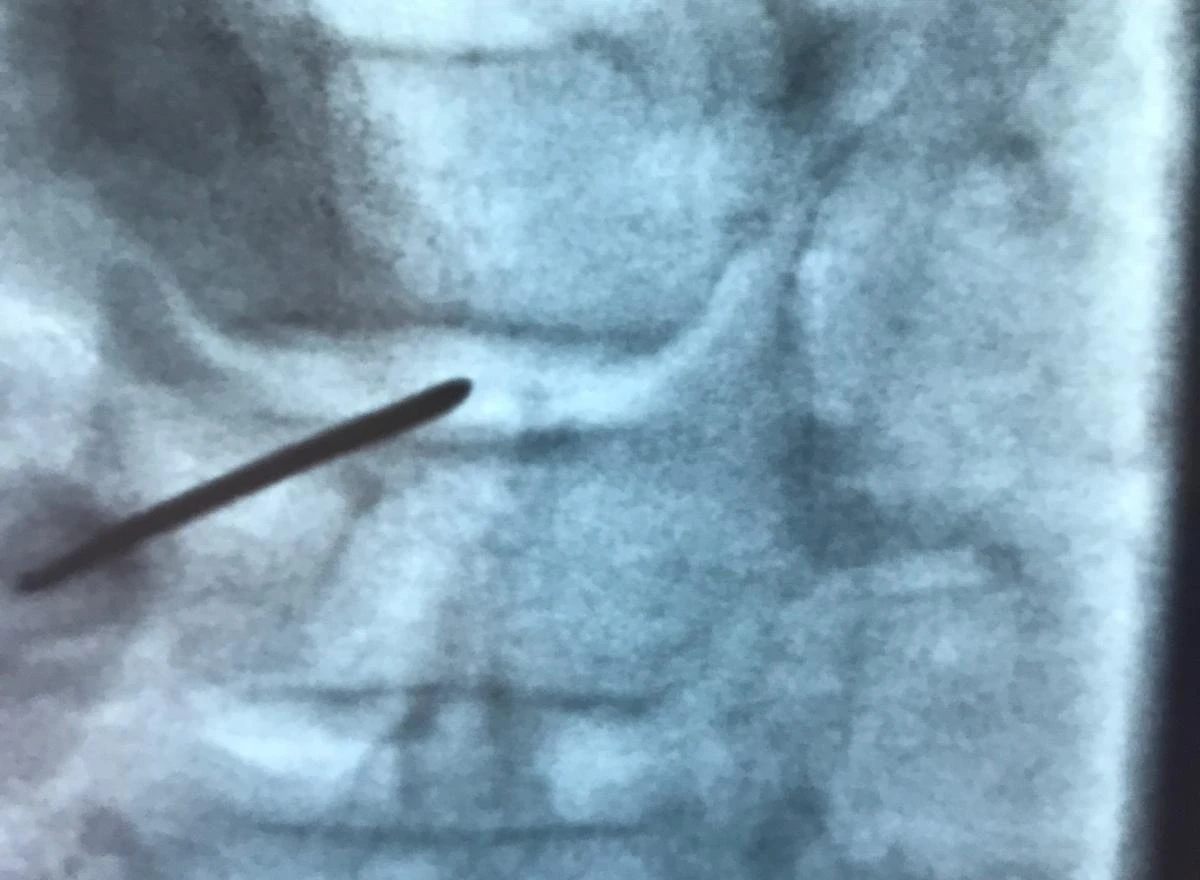
Fluoroscopy shows the needle inside the spine in real time — we see exactly where it goes.
Your Doctor
Dr. Tariq Sinan — Interventional Radiologist
- Specialized fellowship in spine and joint procedures — Dublin, Ireland
- Established Kuwait's first spine pain clinic (2005)
- Other doctors learn these spine procedures from him — the first instructor appointed from the Middle East
- Associate Professor, Kuwait University (16 years)
- Fellow, Royal College of Surgeons (Ireland) and Royal College of Radiologists (London)
- Fluent in English and Arabic — trained and practiced in Ireland and Canada
"After the procedure — about two days of mild discomfort. Now I'm back to exercise, walking, swimming, everything."
Tariq Abu Aziz, spine patient
The Full Story
For those who want to understand the approach in depth
Why Pills Aren't Enough
Pain medication works — that's not the question. It reduces inflammation system-wide, it blocks pain signals, it lets you get through the day. But it doesn't change what's happening in your spine.
The disc is still pressing on the nerve. The joint is still inflamed. The nerve is still irritated. You're managing symptoms, not addressing the source. And over time, you may need higher doses, or different medications, or you start worrying about long-term effects.
There's a difference between reducing pain everywhere and treating the specific structure that's causing it.
Why Surgery Isn't the Only Alternative
Surgery makes sense for some conditions — when there's significant structural damage, when nerves are severely compressed, when conservative treatment has truly failed. But it's a significant intervention: general anesthesia, hospital admission, weeks of recovery, real risks.
For many patients, there's a step between "keep taking pills" and "go under the knife." Targeted treatment that goes to the source of pain without the magnitude of surgery.
| Approach | How It Works | What It Involves |
|---|---|---|
| Pain Medication | Reduces pain signals throughout your body | Daily pills, ongoing use, systemic effects |
| Spine Surgery | Cuts, removes, or fuses structures | Hospital, general anesthesia, weeks of recovery |
| Targeted Injection | Delivers treatment directly to the source | Office-based, local anesthesia, same-day |
How It Works
The key is precision. Instead of flooding your system with medication, we deliver treatment to the exact spot where the problem is — an inflamed joint, a compressed nerve, a damaged disc.
See the Problem
The ultrasound shows your spine in real-time — the vertebrae, the discs, the facet joints, the nerves. We can see exactly which structure is causing trouble, not just where it hurts.
Guide the Needle
Watching the screen, we advance a thin needle to precisely that spot. You can see it approach the target — the inflamed joint, the irritated nerve. No guessing, no hoping we're in the right place.
Treat the Source
We deliver the treatment directly where it's needed — anti-inflammatory medication, healing factors from your own blood, or controlled energy to calm overactive pain nerves. The treatment stays local.
Walk Out
20-30 minutes, start to finish. You're awake throughout — just local numbing at the injection site. No grogginess, no hospital bed, no weeks of recovery. You go home the same day.
The Treatments
Different problems need different approaches. We choose based on what's causing your pain — and what imaging shows us.
Ultrasound-Guided Injections

Epidural Injection
Anti-inflammatory medication delivered into the epidural space — the area surrounding your spinal nerves. A thin needle slides between the vertebrae, and you can watch on the ultrasound as medication spreads around the irritated nerve root.
Facet Joint Injection
The small joints along your spine can become arthritic or inflamed. We guide the needle directly into the joint space and inject anti-inflammatory medication — calming the inflammation where it starts.
PRP Therapy
We draw a small sample of your blood, spin it to concentrate the platelets and growth factors, then inject them into damaged tissue — a worn disc, a strained ligament. Your body's own repair signals, delivered precisely where they're needed.
Disc Treatment (Ozone)
Medical-grade ozone gas injected into a bulging disc causes it to shrink. The disc pulls back from the nerve it was pressing on. We also use ozone in the muscles around your spine to reduce inflammation and promote healing.

Radiofrequency Treatment

Nerve Ablation (RFA)
For facet joint pain that keeps returning, we position a probe next to the tiny nerve carrying pain from that joint. Radiofrequency heat ablates the nerve — it stops transmitting pain. The nerve regenerates over months, but relief often lasts 6-12 months or longer.
Nerve Calming (PRF)
For sciatica and nerve root pain, we use pulsed radiofrequency — gentle energy pulses that calm an irritated nerve without destroying it. The nerve keeps working normally; just the pain signals quiet down. A gentler option when we want to preserve nerve function.
Hospital-Based Procedures
For more complex cases — when office-based treatments aren't enough — we also offer minimally invasive procedures in a hospital setting. These use light sedation rather than local anesthesia only, but they're still far less invasive than traditional open spine surgery. No large incisions. No general anesthesia. Same-day or next-day discharge.
Scar Tissue Release (Epidurolysis)
Scar tissue can build up in the spinal canal — from previous surgery, long-term disc problems, or chronic inflammation — trapping nerves. We thread a thin catheter into that space and break up the adhesions, creating room for the nerves to move freely again.
Disc Decompression (Nucleoplasty)
A herniated disc pressing on a nerve — like a balloon pushing where it shouldn't. A small probe enters the disc under imaging guidance and removes some of the gel-like material inside. The disc shrinks back, pressure on the nerve releases. Not open surgery — a probe-based approach that preserves the disc.
Vertebral Fracture Repair (Kyphoplasty)
A collapsed vertebra — from osteoporosis, a fall, or a fracture — causing severe pain and spinal deformity. A small balloon goes in through a needle, inflates to restore the bone's height, then medical cement is injected to hold it in place. The cement sets in fifteen minutes. You walk out the same day.
Some patients combine these approaches with lower-dose medication. Others reduce or stop pills entirely. We'll discuss what's realistic for your situation.
Common Questions
Can I reduce my pain medication after this?
Many patients do — some significantly, some entirely. It depends on your condition, how you respond, and what's realistic for your situation. We'll discuss expectations during consultation. The goal is to address the source so you don't need to rely on pills as much.
Why this instead of surgery?
This isn't a replacement for surgery when surgery is truly needed. But for many conditions — facet arthritis, disc inflammation, nerve irritation — targeted treatment can provide relief without the magnitude of an operation. If surgery becomes necessary later, this approach hasn't closed that door.
How is this different from injections I've had before?
Many spine injections are done without image guidance — the doctor estimates where to inject based on landmarks and feel. We use ultrasound to see the structures in real-time and watch the needle reach the exact target. More precision means better chance of reaching the right spot.
How long does the relief last?
It varies by treatment and condition. Anti-inflammatory injections may provide weeks to months of relief. Radiofrequency treatment often lasts 6-12 months or longer. PRP aims to promote actual healing. We'll be realistic about what to expect for your specific situation.
Does it hurt?
You'll feel a pinch when we numb the skin — similar to a dental injection. After that, most patients feel pressure but not pain. You're awake and comfortable throughout.
How many treatments will I need?
Some patients get significant relief from one treatment. Others benefit from a series of 2-3. And some conditions benefit from periodic maintenance. We'll give you a realistic picture based on your specific diagnosis.
What are the risks?
These are generally low-risk procedures compared to surgery. Possible side effects include temporary soreness at the injection site, and rarely, infection or bleeding. Ultrasound guidance reduces risk by letting us see exactly where we're working.
Can I drive myself home?
Usually yes. We only use local anesthesia, so you're fully alert. Some patients prefer to have someone drive them the first time, just to be cautious.
Something Between Pills and Surgery
Find out if targeted treatment could reduce your reliance on pain medication.
Book Your Consultation